

Taxation is one of the most important sources of revenue for the Government and plays a significant role in the economic development of a country. The money collected through taxes is used to finance public services and infrastructure such as roads, education, healthcare, defence, public administration, and various welfare programmes.
In India, taxation is governed by the Constitution of India and various tax laws enacted by the competent legislature. One of the fundamental constitutional principles of taxation is contained in Article 265 of the Constitution of India, which provides that “No tax shall be levied or collected except by authority of law.” In simple terms, the Government cannot impose or collect a tax unless it has legal authority to do so.
The Indian taxation system broadly consists of direct taxes and indirect taxes. Direct taxes are imposed directly on the income or taxable amounts of persons and entities, while indirect taxes are generally imposed on the supply of goods and services. Income tax and corporate income tax are important examples of direct taxation, whereas the Goods and Services Tax (GST) is the principal form of indirect taxation in India.
Taxation law is therefore not limited to the payment of tax. It also deals with the determination of tax liability, assessment, filing of returns, deductions, exemptions, compliance requirements, tax administration, appeals, penalties, and the rights and obligations of taxpayers.
Understanding taxation law is important not only for law and taxation students but also for individuals, professionals, entrepreneurs, startups, and established businesses. A basic understanding of the tax system helps taxpayers comply with their legal obligations, structure transactions appropriately, understand available deductions and exemptions, and avoid unnecessary disputes and penalties.
This guide provides a foundation for understanding Taxation Law in India, beginning with the meaning and purpose of tax and gradually covering the major types of taxes, constitutional framework, important tax laws, tax authorities, and practical application of taxation in everyday life and business
What is Tax?
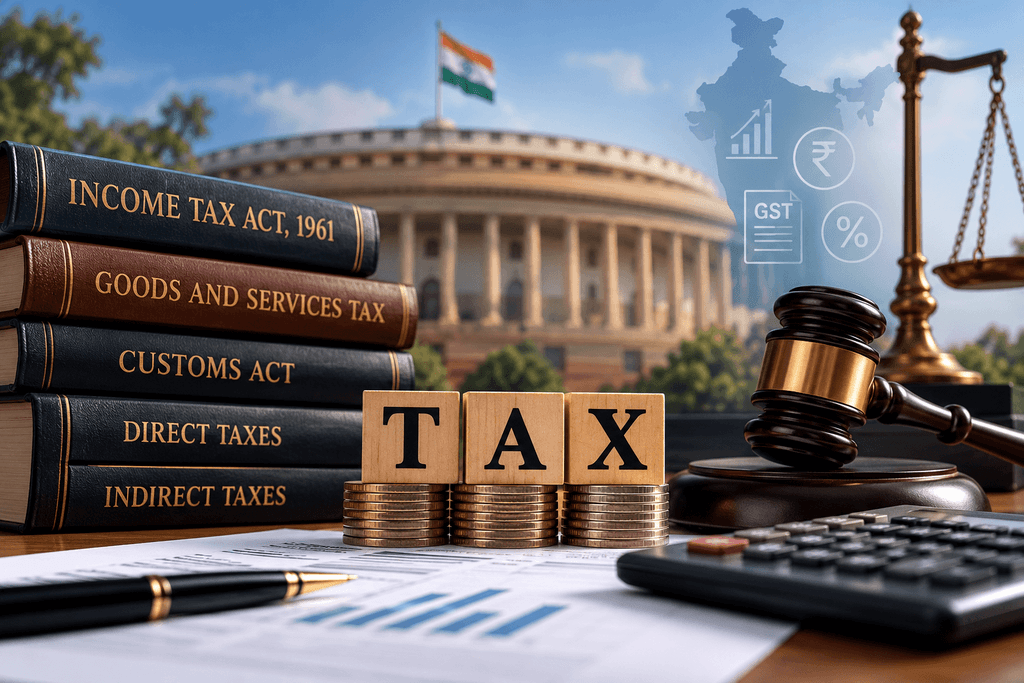
A tax is a compulsory financial charge imposed by the Government on individuals, businesses, companies, and certain transactions in accordance with law. The revenue collected through taxes is used by the Government to fund public expenditure and services such as infrastructure, healthcare, education, defence, administration, and welfare programmes.
In simple words, when a person earns taxable income, a company earns taxable profits, or a taxable supply of goods or services takes place, tax may become payable according to the applicable tax law.
An important feature of a tax is that it is a compulsory payment. It is not a voluntary contribution or donation. However, a taxpayer does not receive a specific or direct service in return for the exact amount of tax paid. Instead, tax revenue forms part of government revenue and is used for broader public purposes.
Practical Example
Suppose Rahul runs a digital marketing agency in India.
During the financial year, his business earns income from providing marketing services to different clients. After considering the applicable provisions relating to business income, allowable expenses, deductions, and other relevant rules, Rahul may have taxable income on which income tax becomes payable.
Taxation can also arise when his business provides services to customers. If his business is required to be registered under GST and the particular service is taxable, it may charge GST on its invoice.
For example, if the taxable value of a service is ₹50,000 and the applicable GST rate is 18%, the invoice may contain:
Service Value: ₹50,000
GST @ 18%: ₹9,000
Total Invoice Value: ₹59,000
The ₹9,000 GST collected from the customer is dealt with under the GST law, including applicable rules regarding input tax credit and payment of net tax liability to the Government.
This example also demonstrates an important distinction: income tax generally concerns taxable income, while GST is an indirect tax connected with taxable supplies of goods and services. Therefore, the same business may have obligations under different tax laws depending on its activities and circumstances.
Key Takeaway: Tax is a compulsory payment imposed under the authority of law. Different taxes apply to different taxable events, such as earning taxable income or making taxable supplies of goods and services.
Constitutional Basis of Taxation in India
The power of the Government to impose and collect taxes in India originates from the Constitution of India. The Constitution not only authorises taxation but also determines which level of government has the power to make laws relating to different taxes.
India has a federal system in which taxation powers are distributed between the Union Government and the State Governments. After the introduction of the Goods and Services Tax (GST), the Constitution also specifically provides for legislative powers of both Parliament and State Legislatures in relation to GST.
1. Article 265 – Tax Only by Authority of Law
Article 265 of the Constitution of India lays down one of the most fundamental principles of Indian taxation:
“No tax shall be levied or collected except by authority of law.”
This means that the Government cannot impose or collect a tax merely through an administrative decision. There must be a valid law authorising the levy and collection of that tax.
Practical Example: Suppose the Government wants to impose a new tax on a particular category of income. Such a tax cannot simply be collected through an executive announcement. It must have proper legal authority in accordance with the Constitution and applicable legislation.
Therefore, Article 265 protects taxpayers against taxation without legal authority.
2. Article 246 – Distribution of Legislative Powers
Article 246, read with the Seventh Schedule of the Constitution, distributes legislative powers between Parliament and the State Legislatures.
The Seventh Schedule contains three lists:
- Union List (List I): Matters on which Parliament generally has exclusive legislative power.
- State List (List II): Matters on which State Legislatures generally have exclusive legislative power, subject to the Constitution.
- Concurrent List (List III): Matters on which both Parliament and State Legislatures can legislate, subject to the constitutional scheme.
Taxation powers are allocated through specific entries in these constitutional lists.
Example: Taxes on income other than agricultural income fall within the Union List, while taxes on agricultural income are allocated to the States under the constitutional distribution of legislative powers.
3. Article 246A – Special Provision for GST
The introduction of the Goods and Services Tax (GST) required a special constitutional framework.
Article 246A, introduced through the Constitution (One Hundred and First Amendment) Act, 2016, gives Parliament and State Legislatures power to make laws relating to GST.
However, where the supply of goods or services takes place in the course of inter-State trade or commerce, Parliament has exclusive legislative power regarding GST.
This constitutional arrangement enables both the Union and the States to participate in India’s GST system.
4. Article 269A – GST on Inter-State Supplies
Article 269A deals with GST on supplies taking place in the course of inter-State trade or commerce.
It provides that GST on such supplies is levied and collected by the Government of India and apportioned between the Union and the States in the manner provided by Parliament by law on the recommendations of the GST Council.
Practical Example: If a registered business in one State makes a taxable inter-State supply to a customer in another State, Integrated Goods and Services Tax (IGST) may apply according to the GST laws. Article 269A provides the constitutional foundation for the levy and collection of GST on inter-State supplies.
5. Article 279A – GST Council
Article 279A provides for the constitution of the Goods and Services Tax Council (GST Council).
The GST Council is an important constitutional body in India’s GST framework. It consists of representatives of the Union and State Governments and makes recommendations on important GST-related matters, including specified aspects of tax rates, exemptions, model laws, threshold limits and other matters mentioned in Article 279A.
Why Is the Constitutional Framework Important?
The constitutional framework ensures that taxation in India operates according to law and within the legislative powers assigned to different governments. A valid tax must therefore have proper constitutional and statutory authority.
In simple terms:
Constitution → Grants and distributes taxation powers → Legislature enacts tax laws → Government administers and collects taxes according to those laws.
Key Takeaway
The Constitution of India is the foundation of India’s taxation system. Article 265 establishes that no tax can be imposed or collected without authority of law, while Articles 246 and 246A distribute legislative powers. Articles 269A and 279A provide important parts of the constitutional framework governing GST.
Types of Taxes in India
Taxes in India can broadly be understood under two major categories: Direct Taxes and Indirect Taxes. The basic difference is whether the tax burden is paid directly by the taxpayer or is collected through transactions involving goods and services.
1. Direct Tax
A direct tax is a tax imposed directly on the income or taxable amount of an individual, company, or other person. The person who is liable to pay the tax generally bears the tax burden himself and cannot ordinarily shift that liability to someone else.
Income tax is the most common example of a direct tax.
Real-Life Example – Salary Income
Suppose Rahul works for an IT company and earns a salary. If his taxable income exceeds the applicable exemption limits and tax becomes payable under the income-tax law, he will have to pay income tax according to the applicable provisions and tax rates.
For example:
Annual Salary: ₹12,00,000
Less: Applicable exemptions/deductions, if available
Taxable Income: Calculated according to the applicable tax law
Income Tax: Calculated according to the applicable tax rates
The important point is that the tax is imposed on Rahul’s taxable income, and Rahul ultimately bears that tax burden.
Therefore, Income Tax is a Direct Tax.
Real-Life Example – Business
Suppose Priya owns a consultancy business. During the year, she earns ₹15 lakh from clients and incurs ₹5 lakh of allowable business expenses.
Her business profit would broadly be:
₹15 lakh − ₹5 lakh = ₹10 lakh
Subject to the applicable provisions of income-tax law, this business income would be considered while determining her taxable income and tax liability.
Again, the tax is directly connected with the taxpayer’s income.
2. Indirect Tax
An indirect tax is generally imposed on the supply of goods or services. The tax may be collected by a registered supplier from the customer and subsequently paid to the Government in accordance with the applicable law.
The most important example of an indirect tax in India is Goods and Services Tax (GST).
Real-Life Example – Buying a Smartphone
Suppose you visit an electronics store and purchase a smartphone.
Assume:
Price before GST: ₹50,000
Applicable GST: 18%
GST Amount: ₹9,000
Total Amount Paid: ₹59,000
You pay ₹59,000 to the seller, including ₹9,000 as GST.
The seller collects GST as part of the transaction and accounts for it under GST law. Subject to applicable input tax credit and other provisions, the seller pays the required net GST liability to the Government.
In this situation:
Customer → Bears the economic burden of GST
Seller → Collects and deposits/accounts for GST under the law
This is why GST is classified as an indirect tax.
Another Everyday Example
You may encounter indirect taxation when you:
- eat at a restaurant,
- stay at a hotel,
- purchase clothes,
- buy electronic products, or
- purchase various taxable services.
Whether GST applies and the applicable rate depend on the particular goods or services and the relevant GST provisions.
Direct Tax vs Indirect Tax – Simple Comparison
| Basis | Direct Tax | Indirect Tax |
| Tax is generally imposed on | Income/taxable amount of a person | Supply of goods or services |
| Who bears the burden? | Taxpayer himself | Generally the final consumer |
| Can burden generally be shifted? | No | Yes |
| Main Example | Income Tax | GST |
| Real-Life Situation | Income tax on salary/business income | GST while purchasing a taxable product |
Easy Way to Remember
You earn taxable income → Direct Tax may arise.
You purchase taxable goods/services → Indirect Tax may form part of the price.
For example, if Rahul earns salary, income tax may apply to his taxable income. When Rahul later buys a smartphone, GST may be included in the price.
Therefore, the same person can bear both direct and indirect taxes, but they arise from different taxable events.
Key Takeaway
India’s taxation system broadly includes direct and indirect taxes. Income tax is a major direct tax because it is imposed directly on taxable income, whereas GST is a major indirect tax because it is imposed on taxable supplies and its economic burden is generally passed on to the final consumer.
Understanding this distinction provides the foundation for studying India’s Income Tax and GST laws in greater detail.
Major Tax Laws in India
India’s taxation system is governed by different laws dealing with direct and indirect taxes. These laws determine who is liable to pay tax, how tax is calculated, the procedure for filing returns, available deductions or exemptions, assessment procedures, penalties, appeals, and other compliance requirements.
Some of the major tax laws in India are discussed below.
1. Income-tax Act, 2025
The Income-tax Act, 2025 is the principal legislation governing income tax in India from 1 April 2026. It replaced the Income-tax Act, 1961.
The Act deals with taxation of income earned by different categories of taxpayers, including:
- Individuals
- Hindu Undivided Families (HUFs)
- Firms
- Companies
- Association of Persons (AOPs)
- Bodies of Individuals (BOIs)
- Other persons covered by the Act
It contains provisions relating to taxable income, deductions, computation of income, tax administration, assessment, tax deduction at source, advance tax, returns, appeals and other income-tax matters.
Real-Life Example:
Suppose Rahul operates a consultancy business and earns taxable business income. His income-tax liability is determined according to the applicable provisions of the Income-tax Act and the relevant Finance Act.
2. Finance Act
A Finance Act is enacted as part of the Union Government’s annual financial and taxation exercise.
It is particularly important because it may prescribe or amend matters such as:
- Income-tax rates
- Tax slabs
- Surcharge
- Tax-related amendments
- Deductions and exemptions
- Other taxation provisions
Therefore, while the Income-tax Act provides the broader legal framework, the relevant Finance Act must also be considered when determining the tax rules applicable for a particular period.
3. Central Goods and Services Tax Act, 2017
The Central Goods and Services Tax Act, 2017 (CGST Act) is one of the principal laws governing GST in India.
It contains provisions dealing with matters such as:
- Levy and collection of CGST
- Registration
- Time and value of supply
- Input Tax Credit (ITC)
- Tax invoices
- Returns
- Payment of tax
- Assessment
- Refunds
- Offences and penalties
Real-Life Example:
Suppose a GST-registered retailer in Uttarakhand sells taxable goods to a customer within Uttarakhand. Subject to the applicable GST provisions, CGST and SGST may be charged on the intra-State supply.
4. Integrated Goods and Services Tax Act, 2017
The Integrated Goods and Services Tax Act, 2017 (IGST Act) primarily deals with GST on inter-State supplies of goods and services and contains important rules relating to the place of supply.
Real-Life Example:
Suppose a GST-registered business in Uttarakhand supplies taxable goods to a business in Delhi and the transaction qualifies as an inter-State supply. IGST would generally apply instead of CGST and SGST.
5. State GST Acts
Each State has its own State Goods and Services Tax (SGST) legislation, operating alongside the CGST framework for intra-State supplies.
For example, Uttarakhand has the Uttarakhand Goods and Services Tax Act, 2017.
In a normal taxable intra-State transaction, GST is generally divided into:
CGST → Central Government component
SGST → State Government component
For example, where an intra-State supply attracts GST at 18%, it may ordinarily consist of 9% CGST + 9% SGST, subject to the applicable classification and rate.
6. Union Territory Goods and Services Tax Act, 2017
The Union Territory Goods and Services Tax Act, 2017 (UTGST Act) provides the GST framework applicable to specified Union Territories.
In applicable intra-Union Territory transactions, CGST and UTGST operate together in a manner broadly comparable to CGST and SGST in States.
7. Customs Act, 1962 and Customs Tariff Act, 1975
Customs taxation is particularly relevant to the import and export of goods.
The Customs Act, 1962 contains the legal framework relating to customs administration, import/export procedures, assessment, clearance, confiscation and related matters.
The Customs Tariff Act, 1975 deals with customs tariff and duties applicable to goods.
Real-Life Example:
Suppose an Indian company imports machinery from another country. The import may attract applicable customs duties and other import-related taxes according to customs and GST laws.
Quick Overview
| Tax Law | Mainly Deals With |
| Income-tax Act, 2025 | Taxation of income |
| Finance Act | Annual tax rates and amendments |
| CGST Act, 2017 | Central GST framework |
| IGST Act, 2017 | Inter-State GST |
| State GST Acts | State component of GST |
| UTGST Act, 2017 | GST in applicable Union Territories |
| Customs Act, 1962 | Customs administration and import/export procedures |
| Customs Tariff Act, 1975 | Customs tariffs and duties |
Key Takeaway
India does not have a single law governing every type of tax. Income tax, GST and customs are governed by separate statutory frameworks. Understanding which law applies to a particular transaction is therefore one of the first steps in determining a taxpayer’s rights, liabilities and compliance obligations.
Important Tax Authorities in India
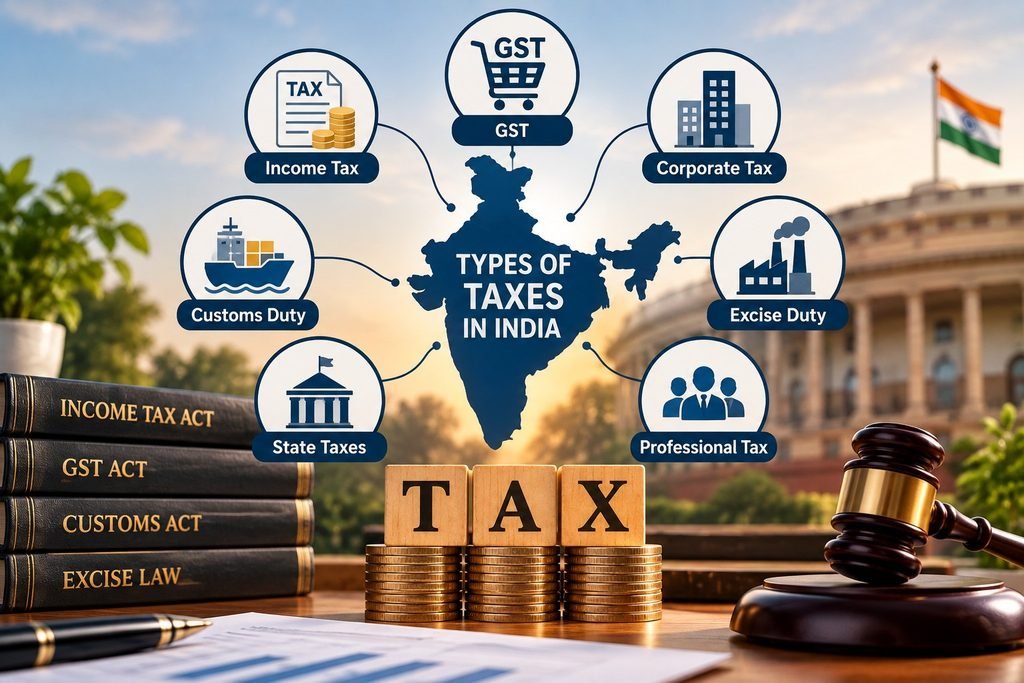
India has several authorities responsible for the administration, collection, enforcement, and implementation of tax laws. Different authorities deal with different types of taxes. At the Central Government level, two of the most important organisations are the Central Board of Direct Taxes (CBDT) and the Central Board of Indirect Taxes and Customs (CBIC).
1. Central Board of Direct Taxes (CBDT)
The Central Board of Direct Taxes (CBDT) is the principal authority dealing with the administration of direct taxes, particularly income tax, under the Department of Revenue, Ministry of Finance.
CBDT plays an important role in:
- Administration of direct tax laws
- Formulation of direct-tax policies
- Issuing circulars, notifications and administrative instructions
- Supervising the Income Tax Department
- Taxpayer services and implementation of direct-tax measures
Real-Life Example
Suppose Rahul earns salary as well as income from his consultancy business and is required to file an income-tax return.
The Income Tax Department, functioning under the administrative framework of CBDT, deals with matters such as return processing, tax payments, assessments, refunds and other income-tax compliance.
2. Income Tax Department
The Income Tax Department is responsible for administering and enforcing India’s income-tax law under the supervision of CBDT.
Taxpayers commonly interact with the Income Tax Department for matters such as:
- PAN
- Filing Income Tax Returns (ITRs)
- Payment of income tax
- TDS-related matters
- Income-tax refunds
- Assessments and notices
- Appeals and other tax proceedings
Practical Example
Suppose Priya files her income-tax return and has paid more tax through TDS than her final tax liability. Subject to verification and processing of her return, she may become entitled to an income-tax refund.
Her interaction in relation to that refund would be with the Income Tax Department.
3. Central Board of Indirect Taxes and Customs (CBIC)
The Central Board of Indirect Taxes and Customs (CBIC) is an important authority under the Department of Revenue, Ministry of Finance.
It primarily deals with the administration of central indirect taxes and customs, including matters relating to:
- Central GST
FAQs – Taxation Law in India
1. What is taxation law?
Taxation law refers to the legal rules governing the levy, collection, administration, and payment of taxes. It defines who must pay tax, how much tax is payable, and the rights and duties of taxpayers and tax authorities.
2. What are the main types of taxes in India?
Taxes are broadly divided into Direct Taxes and Indirect Taxes. Direct taxes, such as income tax, are paid directly by the taxpayer, while indirect taxes, such as GST, are generally collected through the supply of goods and services.
3. What is the constitutional basis for taxation in India?
Article 265 of the Constitution of India provides that “No tax shall be levied or collected except by authority of law.” This means the government cannot impose or collect a tax unless it is authorised by a valid law.
4. What is the difference between direct and indirect tax?
A direct tax is imposed directly on a person’s income or other taxable base and is generally borne by that person. Income tax is a common example. An indirect tax is imposed on transactions involving goods or services and may ultimately be borne by the consumer. GST is the main example.
5. What is GST?
Goods and Services Tax (GST) is an indirect tax imposed on the supply of goods and services. India introduced GST on 1 July 2017, replacing several central and state indirect taxes.
6. Who administers taxes in India?
The Central Board of Direct Taxes (CBDT) administers direct taxes, while the Central Board of Indirect Taxes and Customs (CBIC) deals with central indirect taxes, including GST and customs. State GST authorities also administer GST within their respective jurisdictions.
7. Why does the government collect taxes?
The government uses tax revenue to finance public services and infrastructure, including education, healthcare, roads, defence, public administration, and welfare programmes.
8. Is paying tax compulsory in India?
Yes. When a person falls within the requirements of an applicable tax law, compliance with that law is legally mandatory. However, whether tax is actually payable depends on factors such as income, transactions, exemptions, deductions, and applicable tax provisions.
9. What happens if a person does not pay tax?
- Non-payment, under-reporting, or other non-compliance may result in interest, penalties, recovery proceedings, and, in serious cases, prosecution, depending on the applicable tax law and circumstances.
- 10. Where can taxpayers find official tax information?
- For reliable and updated information, taxpayers can refer to the Income Tax Department, GST Portal, CBIC, and relevant legislation and government notifications.
- Integrated GST
- Customs
- Central Excise on goods that remain within its scope
- Prevention of smuggling
- Administration of relevant indirect-tax laws
Real-Life Example
Suppose a registered business supplies taxable goods and services and is required to comply with GST requirements. Matters concerning Central GST administration fall within the indirect-tax administrative framework headed by CBIC.
Similarly, if a company imports goods into India, customs authorities operating under this framework may become relevant.
4. GST Authorities
GST in India involves both the Central Government and State Governments.
Depending on the taxpayer and the matter involved, GST administration may involve:
Central Tax Authorities → operating under CBIC
State Tax Authorities → operating under the respective State Government
These authorities perform functions relating to registration, return compliance, assessment, audit, investigation, recovery, refunds and enforcement in accordance with GST law.
Practical Example
Suppose ABC Pvt. Ltd. is registered under GST and makes taxable supplies. If its GST return is selected for scrutiny or a discrepancy is identified, the appropriate Central or State GST authority may take action in accordance with the applicable GST law.
5. GST Council
The Goods and Services Tax Council (GST Council) is a constitutional body established under Article 279A of the Constitution of India.
It makes recommendations to the Union and the States on important GST matters, including matters relating to:
- Taxes to be subsumed into GST
- Goods and services that may be subject to or exempt from GST
- Model GST laws
- Threshold limits
- GST rates
- Special provisions for specified States
- Other matters specified under Article 279A
An important distinction should be understood: the GST Council primarily performs a recommendatory and coordinating role in the GST framework. It is different from the tax officers and departments that directly administer GST for individual taxpayers.
6. Customs Authorities
Customs authorities administer laws relating to the import and export of goods.
Their functions include matters such as:
- Assessment and collection of customs duties
- Clearance of imported and exported goods
- Enforcement of customs laws
- Prevention of smuggling and illegal movement of goods
- Implementation of import/export-related customs procedures
Real-Life Example
Suppose an Indian electronics company imports computer equipment from Japan.
When the goods enter India, customs procedures apply. The importer may be required to file the necessary documents, obtain customs clearance and pay applicable duties and taxes before the goods are released, subject to the relevant law.
Quick Summary
| Authority | Main Role |
| CBDT | Administration and policy relating to direct taxes |
| Income Tax Department | Implementation and enforcement of income-tax law |
| CBIC | Central indirect taxes and customs administration |
| Central/State GST Authorities | Administration and enforcement of GST |
| GST Council | Recommendations on important GST matters |
| Customs Authorities | Administration of customs and import/export procedures |
Key Takeaway
India’s tax administration is divided according to the nature of the tax. CBDT and the Income Tax Department primarily deal with direct taxation, while CBIC deals with central indirect taxes and customs. GST administration involves both Central and State authorities, while the GST Council performs an important constitutional recommendatory role in India’s GST framework.
FAQs – Taxation Law in India
1. What is taxation law?
Taxation law refers to the legal rules governing the levy, collection, administration, and payment of taxes. It defines who must pay tax, how much tax is payable, and the rights and duties of taxpayers and tax authorities.
2. What are the main types of taxes in India?
Taxes are broadly divided into Direct Taxes and Indirect Taxes. Direct taxes, such as income tax, are paid directly by the taxpayer, while indirect taxes, such as GST, are generally collected through the supply of goods and services.
3. What is the constitutional basis for taxation in India?
Article 265 of the Constitution of India provides that “No tax shall be levied or collected except by authority of law.” This means the government cannot impose or collect a tax unless it is authorised by a valid law.
4. What is the difference between direct and indirect tax?
A direct tax is imposed directly on a person’s income or other taxable base and is generally borne by that person. Income tax is a common example. An indirect tax is imposed on transactions involving goods or services and may ultimately be borne by the consumer. GST is the main example.
5. What is GST?
Goods and Services Tax (GST) is an indirect tax imposed on the supply of goods and services. India introduced GST on 1 July 2017, replacing several central and state indirect taxes.
6. Who administers taxes in India?
The Central Board of Direct Taxes (CBDT) administers direct taxes, while the Central Board of Indirect Taxes and Customs (CBIC) deals with central indirect taxes, including GST and customs. State GST authorities also administer GST within their respective jurisdictions.
7. Why does the government collect taxes?
The government uses tax revenue to finance public services and infrastructure, including education, healthcare, roads, defence, public administration, and welfare programmes.
8. Is paying tax compulsory in India?
Yes. When a person falls within the requirements of an applicable tax law, compliance with that law is legally mandatory. However, whether tax is actually payable depends on factors such as income, transactions, exemptions, deductions, and applicable tax provisions.
9. What happens if a person does not pay tax?
Non-payment, under-reporting, or other non-compliance may result in interest, penalties, recovery proceedings, and, in serious cases, prosecution, depending on the applicable tax law and circumstances.
10. Where can taxpayers find official tax information?
For reliable and updated information, taxpayers can refer to the Income Tax Department, GST Portal, CBIC, and relevant legislation and government notifications.
