

Introduction
Whether you are a law student preparing for examinations, a startup founder planning to launch a business, or a business owner looking to understand your legal responsibilities, Company Law is one of the most important areas of law you should know.
Every registered company in India—from a small private startup to multinational corporations like Tata, Reliance, and Infosys—operates within a legal framework established by Company Law. It governs how companies are incorporated, managed, financed, regulated, and, when necessary, dissolved. By defining the rights, duties, and responsibilities of companies, directors, shareholders, and other stakeholders, Company Law promotes transparency, accountability, and ethical business practices.
In India, the primary legislation governing companies is the Companies Act, 2013, administered by the Ministry of Corporate Affairs (MCA). The Act lays down comprehensive rules relating to company incorporation, corporate governance, directors’ duties, financial reporting, audits, mergers, winding up, and compliance. For listed companies, regulatory oversight is also exercised by the Securities and Exchange Board of India (SEBI), while disputes involving companies are adjudicated by the National Company Law Tribunal (NCLT) and the National Company Law Appellate Tribunal (NCLAT).
Understanding Company Law is no longer limited to lawyers or chartered accountants. Entrepreneurs need it to build legally compliant businesses, investors rely on it to protect their interests, and students require it as a foundation for corporate legal studies and professional examinations. Even individuals who plan to establish a small business or invest in companies can benefit from understanding the basic principles of Company Law.
In this comprehensive beginner’s guide, you will learn:
- What Company Law is and why it is important.
- The legal framework governing companies in India.
- The essential characteristics and different types of companies.
- The rights and responsibilities of directors and shareholders.
- Key What is Company Law?provisions of the Companies Act, 2013.
- Practical examples to simplify complex legal concepts.
- Landmark judicial decisions that have shaped modern Company Law.
- Common misconceptions, frequently asked questions, and practical takeaways.
By the end of this guide, you will have a clear understanding of the fundamental principles of Company Law and how they apply in both academic and real-world business contexts. Whether your goal is to excel in legal studies, start a business, or simply strengthen your knowledge of corporate law, this guide will provide you with a strong foundation.

Evolution of Company Law in India
The evolution of Company Law in India reflects the country’s economic, commercial, and legal development over more than 170 years. Initially influenced by English company law during the British colonial period, Indian company legislation has gradually evolved into a comprehensive framework that addresses the needs of a modern economy. Today, the Companies Act, 2013 serves as the principal legislation governing companies in India, with a strong emphasis on corporate governance, transparency, investor protection, and ease of doing business.
1. The Beginning: Joint Stock Companies Act, 1850
The first legislation relating to companies in India was the Joint Stock Companies Act, 1850, which was largely based on the English Joint Stock Companies Act, 1844. This Act introduced the concept of registration of joint stock companies, allowing businesses to obtain legal recognition through incorporation. Although it was a significant step, the Act did not provide the benefit of limited liability to shareholders.
2. Introduction of Limited Liability (1857)
In 1857, a new Joint Stock Companies Act was enacted, introducing the concept of limited liability in India. Under this principle, the liability of shareholders became limited to the amount unpaid on their shares. This reform encouraged entrepreneurship by reducing the personal financial risk of investors and promoting business expansion.
3. The Companies Act, 1866
To simplify and strengthen the legal framework, the Companies Act, 1866 was enacted. It consolidated the existing laws relating to the incorporation, regulation, and winding up of companies. This legislation marked an important milestone in the development of company law by providing greater clarity and uniformity in corporate regulation.
4. The Indian Companies Act, 1913
The Indian Companies Act, 1913 replaced the earlier legislation and continued the influence of English company law in India. It introduced more detailed provisions relating to company management, accounts, audits, and shareholder protection. This Act remained the principal company law legislation until after India’s independence.
5. The Companies Act, 1956
Following Independence, the Government of India appointed the Bhabha Committee (1950) to review the existing company law. Based on its recommendations and contemporary corporate needs, the Companies Act, 1956 came into force on 1 April 1956.
The 1956 Act became the backbone of Indian corporate law for over five decades. It comprehensively regulated company incorporation, management, share capital, meetings, accounts, audits, mergers, and winding up. As India’s economy expanded, however, the Act required substantial reforms to address globalization, technological advancements, and changing corporate practices.
6. The Companies Act, 2013 – A New Era of Corporate Governance
To modernise India’s corporate legal framework, Parliament enacted the Companies Act, 2013, replacing the Companies Act, 1956. The Act received the President’s assent on 29 August 2013 and was brought into force in phases beginning in September 2013. It introduced a modern regulatory framework focused on transparency, accountability, investor protection, and ease of doing business.
Evolution at a Glance
| Year | Legislation | Key Development |
| 1850 | Joint Stock Companies Act | Introduced registration of joint stock companies. |
| 1857 | Joint Stock Companies Act | Introduced the concept of limited liability. |
| 1866 | Companies Act | Consolidated company law relating to incorporation and winding up. |
| 1913 | Indian Companies Act | Strengthened corporate regulation and shareholder protection. |
| 1956 | Companies Act | Comprehensive legislation governing companies after Independence. |
| 2013 | Companies Act | Modern corporate law focusing on governance, transparency, compliance, and investor protection. |
Some of the landmark reforms introduced by the Companies Act, 2013 include:
- Introduction of the One Person Company (OPC).
- Mandatory Corporate Social Responsibility (CSR) for eligible companies.
- Strengthening of independent directors and corporate governance norms.
- Enhanced disclosure and financial reporting requirements.
- Introduction of class action suits for shareholders.
- Recognition of fast-track mergers and simplified corporate restructuring.
- Strengthening the role of regulatory authorities and tribunals in corporate dispute resolution.
Legal Framework Governing Company Law in India
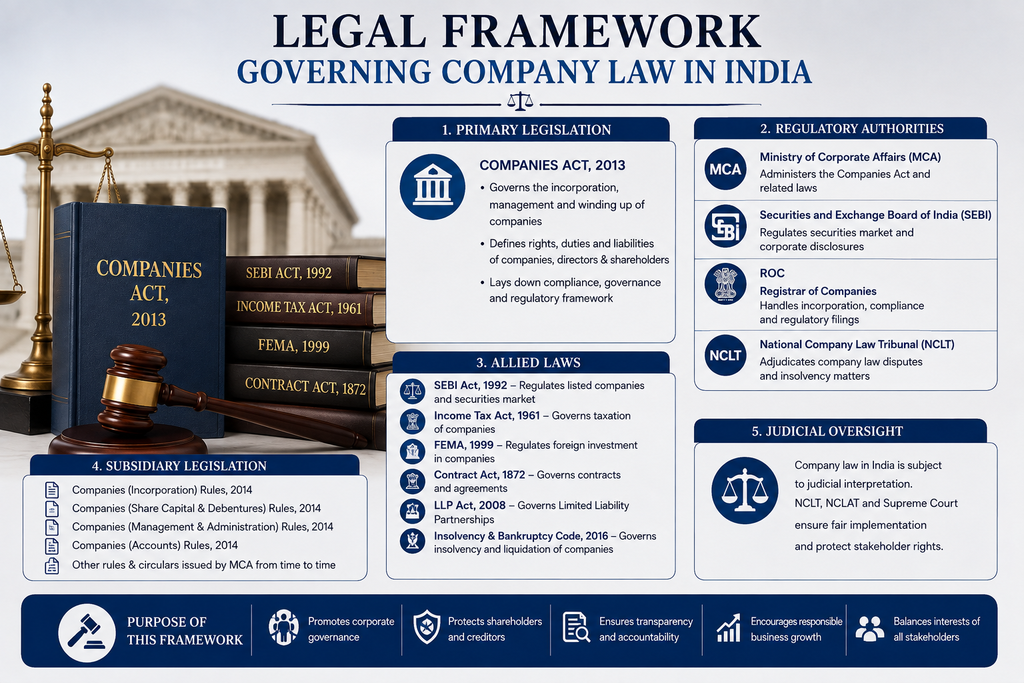
India has a comprehensive legal framework to regulate the incorporation, management, governance, and dissolution of companies. This framework consists of statutes, regulatory authorities, and judicial bodies that work together to ensure transparency, accountability, investor protection, and ease of doing business. The primary legislation governing companies in India is the Companies Act, 2013, which is supported by various rules, notifications, and regulations issued by the Government of India.
Understanding the legal framework is essential for law students, entrepreneurs, business owners, investors, and corporate professionals because every registered company is required to comply with the applicable legal provisions throughout its existence.
The following are the key components of the legal framework governing Company Law in India.
1. Companies Act, 2013
The Companies Act, 2013 is the principal legislation governing companies in India. It replaced the Companies Act, 1956 with the objective of modernising India’s corporate legal system and introducing stronger corporate governance standards.
The Act provides detailed provisions relating to:
- Incorporation and registration of companies.
- Memorandum of Association (MOA) and Articles of Association (AOA).
- Share capital and securities.
- Appointment, powers, duties, and liabilities of directors.
- Meetings of shareholders and the Board of Directors.
- Maintenance of statutory registers and records.
- Preparation of financial statements and statutory audits.
- Corporate Social Responsibility (CSR).
- Mergers, amalgamations, compromises, and arrangements.
- Prevention of oppression and mismanagement.
- Winding up and dissolution of companies.
The Companies Act, 2013 aims to promote transparency, accountability, investor confidence, and responsible corporate governance while facilitating ease of doing business in India.
2. Ministry of Corporate Affairs (MCA)
The Ministry of Corporate Affairs (MCA) is the central government ministry responsible for administering and enforcing the Companies Act, 2013 and other corporate laws in India.
The MCA performs several important functions, including:
- Registering companies through the Registrar of Companies (ROC).
- Monitoring statutory compliance by companies.
- Issuing rules, circulars, notifications, and clarifications.
- Maintaining the MCA portal for online company filings.
- Promoting good corporate governance and compliance.
- Taking regulatory action against companies violating corporate laws.
The MCA acts as the primary regulatory authority responsible for overseeing the corporate sector in India.
3. Registrar of Companies (ROC)
The Registrar of Companies (ROC) functions under the supervision of the Ministry of Corporate Affairs and is responsible for administering the Companies Act within its respective jurisdiction.
The major functions of the ROC include:
- Registering new companies.
- Issuing the Certificate of Incorporation.
- Maintaining company records and statutory filings.
- Ensuring compliance with annual filing requirements.
- Initiating action against defaulting companies where necessary.
The ROC plays a vital role in ensuring that companies comply with the statutory requirements prescribed under the Companies Act, 2013.
4. National Company Law Tribunal (NCLT)
The National Company Law Tribunal (NCLT) is a quasi-judicial body established under the Companies Act, 2013 to adjudicate corporate disputes and matters relating to company law.
The NCLT deals with matters such as:
- Company incorporation disputes.
- Oppression and mismanagement.
- Reduction of share capital.
- Mergers and amalgamations.
- Revival and rehabilitation of companies.
- Corporate insolvency proceedings under the Insolvency and Bankruptcy Code, 2016.
- Winding up of companies.
The establishment of the NCLT has significantly streamlined the resolution of corporate disputes by providing a specialised forum.
5. National Company Law Appellate Tribunal (NCLAT)
The National Company Law Appellate Tribunal (NCLAT) hears appeals against the orders passed by the NCLT.
Its primary functions include:
- Reviewing decisions of the NCLT.
- Ensuring uniform interpretation of company law.
- Hearing appeals relating to corporate insolvency and competition law as provided under applicable statutes.
An appeal against an order of the NCLAT lies before the Supreme Court of India, but only on questions of law.
6. Securities and Exchange Board of India (SEBI)
The Securities and Exchange Board of India (SEBI) is the statutory regulator of India’s securities market. While the Companies Act governs all companies, SEBI primarily regulates listed companies and entities intending to raise capital from the public.
SEBI is responsible for:
- Protecting the interests of investors.
- Regulating the securities market.
- Ensuring fair and transparent trading practices.
- Regulating public issues of securities.
- Enforcing disclosure and corporate governance requirements for listed companies.
- Preventing insider trading, market manipulation, and unfair trade practices.
SEBI works in coordination with the Ministry of Corporate Affairs to strengthen investor confidence and maintain the integrity of India’s capital markets.
7. Other Important Laws Affecting Companies
In addition to the Companies Act, 2013, companies in India are also governed by several other laws depending on the nature of their business, including:
- Insolvency and Bankruptcy Code, 2016 (IBC)
- Securities Contracts (Regulation) Act, 1956
- SEBI Act, 1992
- Limited Liability Partnership Act, 2008 (where applicable)
- Competition Act, 2002
- Income-tax Act, 1961
- Goods and Services Tax (GST) Laws
- Foreign Exchange Management Act, 1999 (FEMA)
- Labour and Employment Laws
- Environmental Laws
These laws collectively ensure that companies operate responsibly and comply with legal obligations across different sectors.
Essential Characteristics of a Company
A company is a unique form of business organisation created through the process of legal incorporation. Unlike a sole proprietorship or partnership, a company enjoys a distinct legal status and possesses several characteristics that distinguish it from other business entities. These characteristics form the foundation of modern Company Law and explain why companies are widely preferred for conducting business, raising capital, and ensuring long-term continuity.
The following are the essential characteristics of a company:
1. Separate Legal Entity
One of the most fundamental characteristics of a company is that it is recognised as a separate legal entity distinct from its shareholders, directors, and members. Once a company is incorporated, it acquires its own legal personality and can own property, enter into contracts, borrow money, sue, and be sued in its own name.
This principle was firmly established in the landmark case of Salomon v. A. Salomon & Co. Ltd. (1897), where the House of Lords held that a duly incorporated company is a legal person separate from its members.
Example:
If XYZ Private Limited purchases an office building, the property belongs to the company—not to its shareholders or directors individually.
2. Perpetual Succession
A company enjoys perpetual succession, which means its existence is not affected by the death, insolvency, retirement, or incapacity of its shareholders or directors. The company continues to exist until it is legally dissolved through the process prescribed by law.
This ensures stability and continuity in business operations, making companies suitable for long-term commercial activities.
Example:
Even if all the original shareholders of a company transfer their shares or pass away, the company continues to exist as the same legal entity.
3. Limited Liability
Another significant feature of a company is limited liability. In most companies, the liability of shareholders is limited to the unpaid amount on the shares held by them or the amount guaranteed by them, depending on the type of company.
This principle protects the personal assets of shareholders from the company’s liabilities, thereby encouraging entrepreneurship and investment.
Example:
If a shareholder has fully paid for 1,000 shares of a company, they are generally not personally liable for the company’s debts beyond their investment, except in exceptional circumstances recognised by law.
4. Artificial Legal Person
A company is regarded as an artificial legal person because it is created by law and does not possess a physical existence like a natural person. Although it cannot think or act independently, it functions through its Board of Directors, officers, and authorised representatives.
As an artificial person, a company can own assets, incur liabilities, enter into contracts, and initiate or defend legal proceedings.
5. Separate Property
The property owned by a company belongs exclusively to the company and not to its shareholders or directors. Even if a shareholder owns a majority of the company’s shares, they cannot claim ownership over the company’s assets in their personal capacity.
This principle reinforces the concept of a separate legal entity and protects the company’s assets from personal claims against its members.
Example:
A director cannot sell a company-owned vehicle as if it were their personal property because the legal ownership vests in the company.
6. Transferability of Shares
In the case of a company limited by shares, ownership can generally be transferred by transferring shares, subject to the provisions of the Companies Act, 2013 and the company’s Articles of Association.
For public companies, shares are freely transferable. In private companies, transferability may be restricted by the Articles of Association.
This feature allows investors to enter or exit a company without affecting its legal existence.
7. Common Seal (Historical Perspective)
Traditionally, a company used a common seal as its official signature to authenticate important documents and contracts. However, after the Companies (Amendment) Act, 2015, the use of a common seal became optional.
Today, authorised directors or company officers may execute documents on behalf of the company in accordance with the provisions of the Companies Act, 2013.
Summary of the Essential Characteristics
| Characteristic | Significance |
| Separate Legal Entity | Company has its own legal identity. |
| Perpetual Succession | Company continues despite changes in membership. |
| Limited Liability | Protects shareholders from unlimited personal liability. |
| Artificial Legal Person | Company exists only through law. |
| Separate Property | Company owns its assets independently. |
| Transferability of Shares | Ownership can be transferred without affecting the company’s existence. |
| Common Seal (Optional) | Traditional mode of authenticating company documents. |
Types of Companies in India
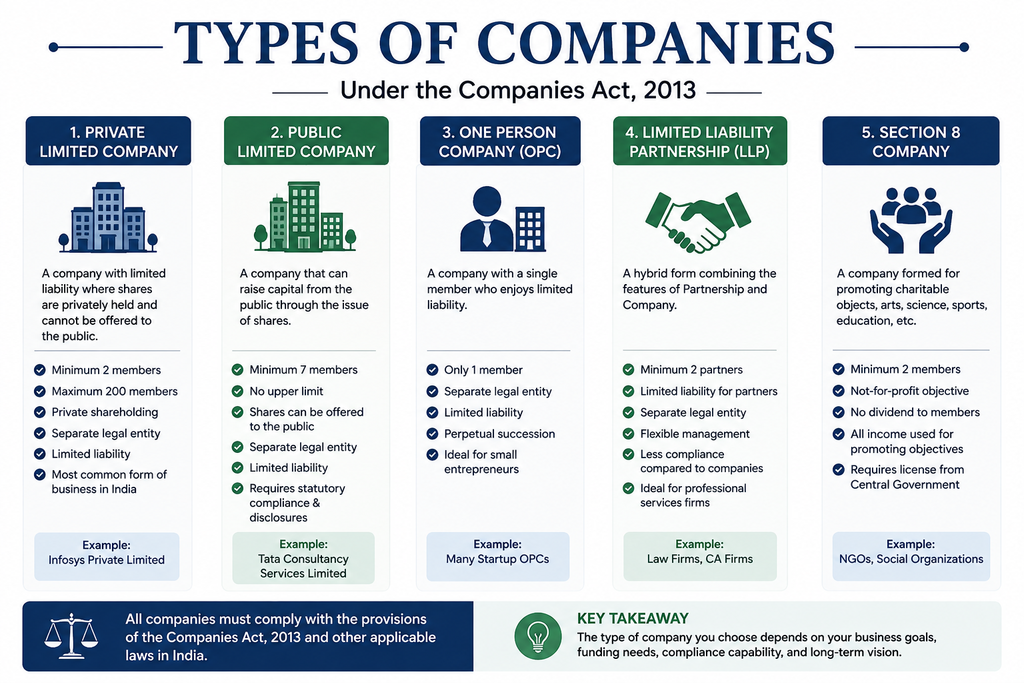
The Companies Act, 2013 recognises different types of companies to meet the diverse needs of businesses, entrepreneurs, investors, charitable organisations, and the Government. The classification of companies depends on factors such as the number of members, liability of members, ownership, control, method of incorporation, and place of incorporation.
Understanding the various types of companies is essential for law students as well as business owners because each type has its own legal requirements, compliance obligations, and operational advantages.
The following are the major types of companies recognised under Indian Company Law.
1. Private Company
A Private Company is defined under Section 2(68) of the Companies Act, 2013. It is the most popular form of business organisation for startups, family businesses, and small and medium-sized enterprises.
Key Features
- Restricts the right to transfer its shares.
- Limits the number of members to 200 (excluding present and former employee-members).
- Prohibits any invitation to the public to subscribe to its securities.
- Must have a minimum of 2 members and 2 directors.
Advantages
- Limited liability protection.
- Greater management flexibility.
- Better privacy than public companies.
- Suitable for startups and closely held businesses.
Example
Most Indian startups begin as Private Limited Companies because they provide legal protection while allowing promoters to retain greater control over the business.
2. Public Company
A Public Company is defined under Section 2(71) of the Companies Act, 2013. It can offer its securities to the general public and is generally subject to stricter regulatory and disclosure requirements.
Key Features
- Minimum 7 members.
- Minimum 3 directors.
- No restriction on the transfer of shares.
- Can invite the public to subscribe to its shares or debentures.
- Listed public companies are additionally regulated by SEBI.
Advantages
- Easy access to public capital.
- Greater business credibility.
- Better opportunities for expansion.
- High liquidity of shares (if listed).
Example
Many large Indian corporations operate as public companies and raise funds from the public through stock exchanges.
3. One Person Company (OPC)
The concept of a One Person Company (OPC) was introduced by the Companies Act, 2013 to encourage individual entrepreneurs to conduct business through a corporate structure.
An OPC is incorporated by one member and enjoys the status of a separate legal entity.
Key Features
- Only one shareholder.
- Limited liability.
- Separate legal entity.
- Perpetual succession.
- Simpler compliance compared to many other company structures.
Advantages
- Ideal for solo entrepreneurs.
- Protects personal assets.
- Provides greater business credibility.
- Enables smooth business expansion.
Example
A freelance software developer wishing to operate as a company without bringing in partners may choose the OPC structure.
4. Section 8 Company
A Section 8 Company is incorporated for promoting charitable or non-profit objectives such as education, social welfare, environmental protection, sports, art, science, religion, or research.
Unlike ordinary companies, a Section 8 Company does not distribute profits to its members. Any profits earned are applied solely towards achieving its stated objectives.
Key Features
- Non-profit motive.
- Income is utilised for charitable purposes.
- Limited liability.
- Licensed by the Central Government.
Advantages
- High public credibility.
- Tax benefits (subject to applicable laws).
- Suitable for NGOs, educational institutions, and charitable organisations.
Example
Many non-governmental organisations (NGOs) and charitable institutions are incorporated as Section 8 Companies.
5. Government Company
A Government Company is defined under Section 2(45) of the Companies Act, 2013.
It is a company in which not less than 51% of the paid-up share capital is held by the Central Government, one or more State Governments, or jointly by both.
Key Features
- Majority government ownership.
- Operates under the Companies Act, 2013.
- Subject to additional government oversight.
- May perform commercial as well as public welfare functions.
Example
Many public sector undertakings (PSUs) are incorporated as Government Companies.
6. Foreign Company
Under Section 2(42) of the Companies Act, 2013, a Foreign Company is a company incorporated outside India that has a place of business in India and conducts business activities in India, either directly or through electronic means.
Key Features
- Incorporated outside India.
- Carries on business within India.
- Required to comply with applicable provisions of the Companies Act, 2013.
- Must comply with FEMA and other applicable laws wherever required.
Example
A multinational corporation incorporated outside India that establishes a branch office or liaison office in India may fall within the scope of a foreign company.
7. Holding Company
A Holding Company is defined under Section 2(46) of the Companies Act, 2013.
A company becomes a holding company when it exercises control over another company, known as its subsidiary company.
Control may arise through:
- Majority voting power; or
- Control over the composition of the Board of Directors.
Example
A parent company owning more than half of the voting rights in another company is generally regarded as its holding company.
8. Subsidiary Company
A Subsidiary Company is defined under Section 2(87) of the Companies Act, 2013.
It is a company that is controlled by another company (the holding company) through voting power or control over the Board of Directors.
Importance
Holding and subsidiary company structures are commonly used by corporate groups for expansion, investment, and efficient business management.
9. Associate Company
According to Section 2(6) of the Companies Act, 2013, an Associate Company is a company in which another company has significant influence, but which is not a subsidiary company.
Generally, significant influence means control of at least 20% of the total voting power, or control over business decisions under an agreement.
10. Dormant Company
The Companies Act, 2013 also recognises the concept of a Dormant Company under Section 455.
A company that has no significant accounting transactions and is formed for a future project or to hold assets or intellectual property may apply to obtain dormant status.
This helps reduce compliance costs until the company resumes active business operations.
Summary of Types of Companies
| Type of Company | Relevant Provision | Primary Purpose |
| Private Company | Section 2(68) | Startups, family businesses, SMEs |
| Public Company | Section 2(71) | Large businesses raising public capital |
| One Person Company (OPC) | Section 2(62) | Individual entrepreneurs |
| Section 8 Company | Section 8 | Charitable and non-profit activities |
| Government Company | Section 2(45) | Government-owned enterprises |
| Foreign Company | Section 2(42) | Foreign businesses operating in India |
| Holding Company | Section 2(46) | Parent company controlling subsidiaries |
| Subsidiary Company | Section 2(87) | Company controlled by a holding company |
| Associate Company | Section 2(6) | Company under significant influence |
| Dormant Company | Section 455 | Future projects or asset holding |
How to Register a Company in India (Step-by-Step Overview)
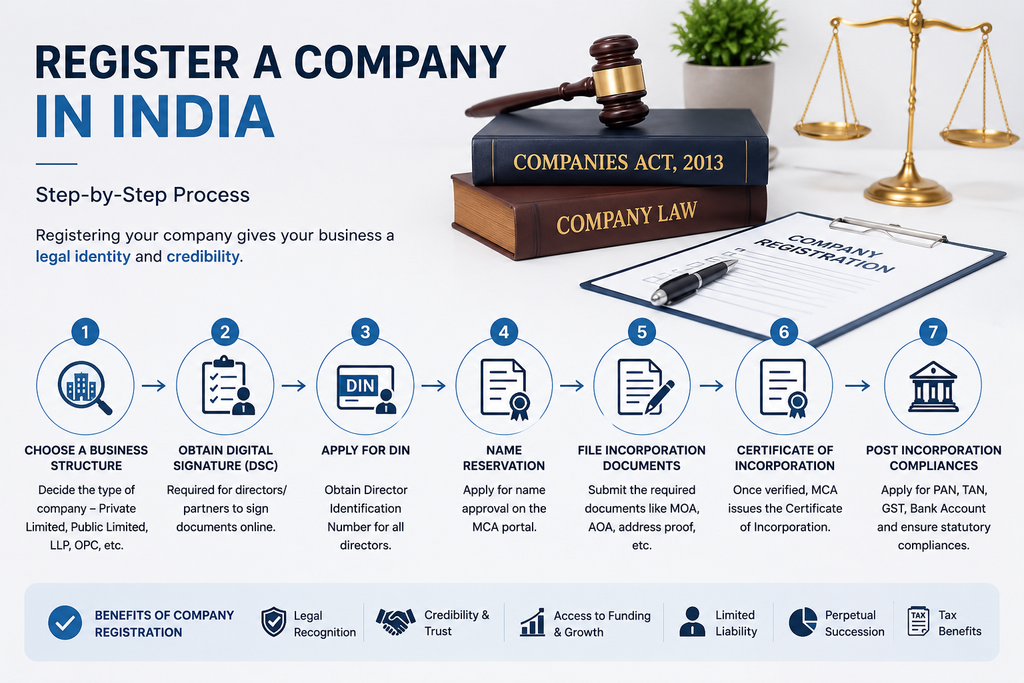
Registering a company in India is a completely online process governed by the Companies Act, 2013 and administered by the Ministry of Corporate Affairs (MCA) through its MCA portal. The incorporation process has been significantly simplified with the introduction of the SPICe+ (Simplified Proforma for Incorporating Company Electronically Plus) system, which integrates multiple registrations into a single application.
Whether you are a startup founder, entrepreneur, or business owner, understanding the incorporation process is essential to ensure legal compliance from the very beginning.
The following is a step-by-step overview of the company registration process in India.
Step 1: Choose the Appropriate Type of Company
The first step is to decide the most suitable business structure based on your business objectives, ownership pattern, funding requirements, and future growth plans.
Common options include:
- Private Limited Company
- One Person Company (OPC)
- Public Limited Company
- Section 8 Company (Non-Profit)
Selecting the appropriate type of company is important because each structure has different legal requirements, compliance obligations, and advantages.
Step 2: Obtain a Digital Signature Certificate (DSC)
A Digital Signature Certificate (DSC) is mandatory for all proposed directors and subscribers because all incorporation documents are filed electronically on the MCA portal. The DSC is used to digitally sign the incorporation forms and supporting documents.
Step 3: Obtain a Director Identification Number (DIN)
Every individual intending to act as a director must possess a Director Identification Number (DIN).
If a proposed director does not already have a DIN, it can generally be allotted through the SPICe+ incorporation application, eliminating the need for a separate application in most cases.
Step 4: Reserve the Company Name
The promoters must select a unique company name that complies with the naming guidelines prescribed under the Companies Act, 2013 and the Companies (Incorporation) Rules, 2014.
The proposed name is applied for through SPICe+ Part A on the MCA portal. Before approval, the Registrar of Companies (ROC) verifies whether the proposed name:
- Is unique.
- Is not identical or deceptively similar to an existing company or LLP.
- Does not violate trademark rights.
- Complies with the MCA naming guidelines.
Step 5: Prepare the Incorporation Documents
After the proposed name is approved, the promoters must prepare the documents required for incorporation.
The important documents include:
- Memorandum of Association (MoA)
- Articles of Association (AoA)
- Identity proof of directors and subscribers
- Address proof of directors and subscribers
- Proof of the registered office
- No Objection Certificate (NOC) from the property owner, where applicable
- Declaration and consent of directors
These documents form the legal foundation of the company.
Step 6: File the SPICe+ Incorporation Form
The incorporation application is filed through SPICe+ Part B, an integrated web-based form available on the MCA portal.
Through this single application, the applicant can simultaneously apply for:
- Company Incorporation
- Director Identification Number (DIN)
- Permanent Account Number (PAN)
- Tax Deduction and Collection Account Number (TAN)
- GST Registration (where applicable)
- EPFO Registration
- ESIC Registration
- Professional Tax Registration (in applicable States)
- Opening of a Bank Account (through participating banks)
Step 7: Verification by the Registrar of Companies (ROC)
After submission, the Registrar of Companies (ROC) examines the incorporation documents.
If the application satisfies all legal requirements, it is approved. If any defect or discrepancy is found, the applicant may be required to provide clarification or resubmit the application after rectifying the defects.
Step 8: Issue of Certificate of Incorporation
Upon successful verification, the ROC issues the Certificate of Incorporation (COI).
The Certificate of Incorporation contains important details such as:
- Company Identification Number (CIN)
- Name of the Company
- Date of Incorporation
- PAN and TAN (where integrated)
The company comes into legal existence from the date mentioned in the Certificate of Incorporation and acquires the status of a separate legal entity.
Step 9: Post-Incorporation Compliances
After incorporation, the company must complete certain initial and ongoing compliance requirements, such as:
- Opening a company bank account.
- Maintaining statutory registers.
- Issuing share certificates.
- Appointing the first auditor (where applicable).
- Maintaining books of accounts.
- Filing annual financial statements and annual returns.
- Holding Board Meetings and Annual General Meetings (AGMs) as required by law.
Timely compliance is essential to avoid penalties and ensure smooth business operations.
Practical Example
Suppose three entrepreneurs wish to establish a technology startup. They decide to incorporate a Private Limited Company. After obtaining DSCs, applying for name approval, preparing the MOA and AOA, and filing the SPICe+ incorporation application, the Registrar of Companies issues the Certificate of Incorporation. From that date, the company becomes a separate legal entity capable of entering into contracts, owning property, raising investment, and carrying on business in its own name.
Corporate Governance under the Companies Act, 2013
Corporate Governance refers to the system of rules, principles, policies, and processes through which a company is directed, controlled, and managed. It establishes a framework that ensures companies operate in a transparent, ethical, and accountable manner while protecting the interests of shareholders, employees, creditors, customers, investors, and other stakeholders.
In India, corporate governance is primarily governed by the Companies Act, 2013. In the case of listed companies, the Securities and Exchange Board of India (SEBI) also prescribes corporate governance standards through the SEBI (Listing Obligations and Disclosure Requirements) Regulations, 2015.
Strong corporate governance promotes responsible decision-making, reduces the risk of fraud and mismanagement, enhances investor confidence, and contributes to the long-term sustainability of a company.
Objectives of Corporate Governance
The primary objectives of corporate governance are:
- To ensure transparency in the management of companies.
- To strengthen accountability of directors and senior management.
- To protect the interests of shareholders and other stakeholders.
- To promote ethical business practices.
- To prevent fraud, corruption, and misuse of corporate resources.
- To improve investor confidence and corporate credibility.
- To ensure compliance with applicable laws and regulations.
- To encourage sustainable business growth.
Key Principles of Corporate Governance
1. Transparency
Companies must disclose accurate, complete, and timely information relating to their financial performance, ownership structure, management decisions, and business operations. Transparency enables investors and stakeholders to make informed decisions.
2. Accountability
The Board of Directors and senior management are accountable for the company’s decisions and actions. They must perform their duties responsibly and remain answerable to shareholders and regulatory authorities.
3. Fairness
Corporate governance requires companies to treat all shareholders, including minority shareholders, fairly and equitably. Decisions should not unfairly favour any particular group at the expense of others.
4. Responsibility
Every company should conduct its business responsibly by complying with legal requirements, respecting stakeholder rights, protecting the environment, and contributing to society.
5. Independence
Independent directors play an important role in ensuring objective decision-making. Their independence helps prevent conflicts of interest and improves corporate oversight.
Important Provisions of the Companies Act, 2013 Relating to Corporate Governance
The Companies Act, 2013 introduced several reforms to strengthen corporate governance in India.
1. Board of Directors
The Act lays down provisions relating to the appointment, qualifications, powers, duties, and responsibilities of directors to ensure effective management and oversight.
2. Independent Directors
Certain classes of companies are required to appoint Independent Directors. They provide unbiased judgment, protect the interests of minority shareholders, and improve the overall governance framework.
3. Duties of Directors
Section 166 of the Companies Act, 2013 imposes statutory duties on directors, requiring them to act in good faith, exercise due care and diligence, avoid conflicts of interest, and work in the best interests of the company.
4. Audit Committee
Specified companies are required to constitute an Audit Committee to oversee financial reporting, internal controls, statutory audits, and risk management. This committee enhances financial transparency and accountability.
5. Nomination and Remuneration Committee
Eligible companies must constitute a Nomination and Remuneration Committee to recommend appointments of directors and key managerial personnel and to ensure fair remuneration policies.
6. Vigil Mechanism (Whistle-Blower Policy)
The Act requires certain companies to establish a Vigil Mechanism that enables directors and employees to report unethical conduct, fraud, or violations of law without fear of retaliation.
7. Corporate Social Responsibility (CSR)
Under Section 135 of the Companies Act, 2013, eligible companies are required to spend a prescribed amount on Corporate Social Responsibility (CSR) activities. This provision encourages businesses to contribute to social and environmental development.
8. Financial Statements and Audit
Companies are required to prepare true and fair financial statements, maintain proper books of accounts, and have their accounts audited by qualified auditors. These measures enhance financial discipline and public confidence.
Role of the Board of Directors in Corporate Governance
The Board of Directors is responsible for ensuring that the company follows sound governance practices. Its key responsibilities include:
- Providing strategic direction.
- Supervising management.
- Ensuring legal and regulatory compliance.
- Managing business risks.
- Protecting stakeholder interests.
- Promoting ethical corporate culture.
- Monitoring financial performance.
Benefits of Good Corporate Governance
An effective corporate governance framework provides several benefits:
- Builds investor confidence.
- Improves access to finance.
- Enhances the company’s reputation.
- Reduces the risk of fraud and corporate scandals.
- Improves operational efficiency.
- Strengthens compliance with laws.
- Protects minority shareholders.
- Promotes long-term business sustainability.
Practical Example
Suppose a listed company plans to undertake a major acquisition. Before approving the transaction, the Board of Directors reviews the proposal, the Audit Committee examines the financial implications, and independent directors assess whether the decision is in the best interests of all shareholders. The company also makes the required disclosures to shareholders and the stock exchange. This process demonstrates the practical application of corporate governance by ensuring transparency, accountability, and informed decision-making.
Importance of Corporate Governance
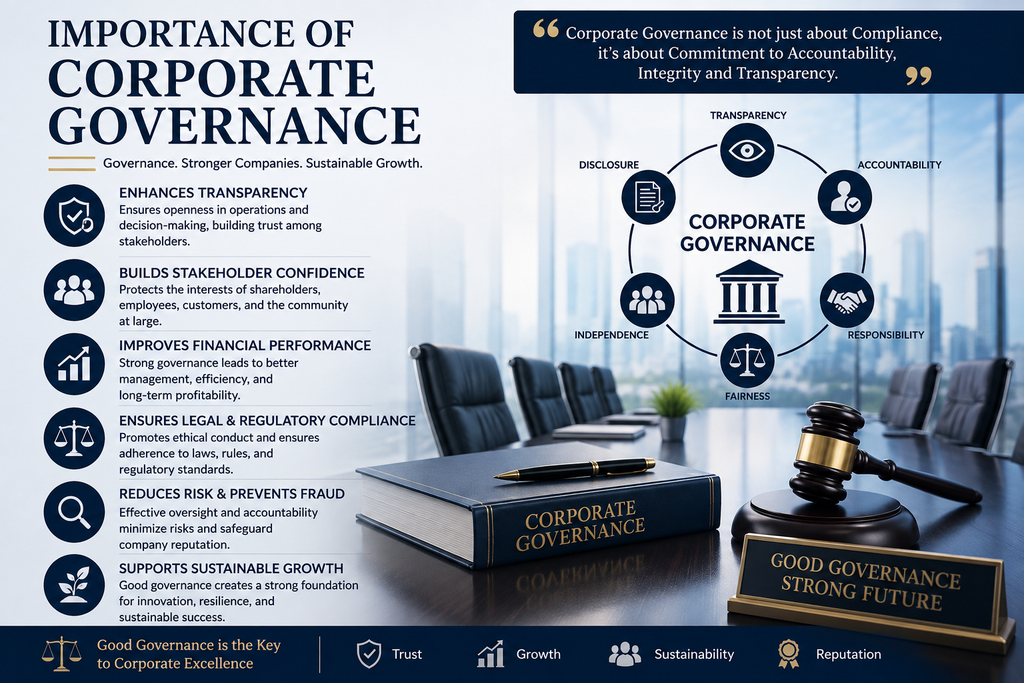
In today’s business environment, investors are increasingly attracted to companies that follow strong corporate governance practices. Effective governance not only ensures compliance with legal requirements but also strengthens public trust, improves business performance, and reduces the likelihood of corporate disputes.
For law students, corporate governance is a fundamental concept in Company Law. For entrepreneurs and business owners, it provides practical guidance on building legally compliant, ethical, and sustainable organisations.
Major Compliance Requirements for Companies
After incorporation, a company is required to comply with various statutory obligations prescribed under the Companies Act, 2013, the rules made thereunder, and other applicable laws. Compliance ensures that the company operates transparently, remains accountable to its stakeholders, and avoids legal penalties. Failure to comply with these requirements may result in fines, disqualification of directors, or other legal consequences.
The following are some of the major compliance requirements applicable to companies in India.
1. Maintenance of Statutory Registers
Every company must maintain statutory registers containing important information relating to its members, directors, charges, share transfers, and other matters as prescribed under the Companies Act, 2013.
These registers serve as official records and help ensure transparency in the company’s affairs.
2. Holding Board Meetings
The Board of Directors must hold meetings at regular intervals in accordance with the Companies Act, 2013. During these meetings, directors discuss important business matters, approve financial statements, review company performance, and make strategic decisions.
Proper notice, agenda, quorum, and minutes of every Board Meeting must be maintained.
3. Annual General Meeting (AGM)
Every company, except where specifically exempted by law, is required to hold an Annual General Meeting (AGM) every year.
At the AGM, shareholders consider important matters such as:
- Adoption of financial statements.
- Declaration of dividends.
- Appointment or reappointment of directors.
- Appointment of auditors.
- Discussion of the company’s overall performance.
The AGM promotes transparency and enables shareholders to participate in important corporate decisions.
4. Preparation and Filing of Financial Statements
Companies must prepare annual financial statements that present a true and fair view of their financial position.
The financial statements generally include:
- Balance Sheet
- Statement of Profit and Loss
- Cash Flow Statement (where applicable)
- Statement of Changes in Equity (where applicable)
- Notes to Accounts
These statements must be approved by the Board of Directors before filing with the Registrar of Companies (ROC).
5. Statutory Audit
Every company is required to have its financial statements audited by a qualified Chartered Accountant appointed as the statutory auditor.
The auditor independently examines the company’s financial records and expresses an opinion on whether the financial statements present a true and fair view of the company’s financial position.
6. Filing of Annual Return
Every company must file an Annual Return with the Registrar of Companies (ROC) containing information relating to:
- Registered office.
- Shareholding pattern.
- Directors and Key Managerial Personnel.
- Members.
- Indebtedness.
- Other prescribed particulars.
This ensures that the corporate records maintained by the Ministry of Corporate Affairs remain updated.
7. Maintenance of Books of Accounts
Every company is required to maintain proper books of accounts reflecting all financial transactions accurately.
Proper accounting records help management, auditors, regulators, investors, and tax authorities assess the company’s financial health.
8. Appointment of Auditor
The company must appoint its statutory auditor in accordance with the provisions of the Companies Act, 2013.
The auditor performs an important role in promoting financial transparency and protecting the interests of shareholders and creditors.
9. Filing of Event-Based Forms
Certain corporate events require immediate reporting to the Registrar of Companies.
Examples include:
- Appointment or resignation of directors.
- Increase in authorised share capital.
- Change in the registered office.
- Allotment of shares.
- Creation or satisfaction of charges.
- Alteration of the Memorandum or Articles of Association.
Timely filing of these forms ensures statutory compliance.
10. Compliance with Other Applicable Laws
Apart from the Companies Act, companies must also comply with several other laws depending on the nature of their business, including:
- Income-tax Act, 1961
- Goods and Services Tax (GST) laws
- Labour and Employment Laws
- Foreign Exchange Management Act, 1999 (FEMA)
- SEBI Regulations (for listed companies)
- Environmental Laws
- Competition Act, 2002
Compliance with these laws is essential for lawful business operations.
Consequences of Non-Compliance
Failure to comply with statutory requirements may lead to:
- Monetary penalties.
- Additional filing fees.
- Disqualification of directors.
- Legal proceedings.
- Regulatory action by the Ministry of Corporate Affairs (MCA).
- Damage to the company’s reputation.
- In serious cases, prosecution and imprisonment where specifically provided by law.
Practical Example
Suppose a company fails to file its Annual Return and Financial Statements within the prescribed time. As a result, the company may be required to pay additional filing fees, and persistent default may expose the company and its officers to statutory penalties under the Companies Act, 2013.
Landmark Case Laws in Company Law
Judicial decisions have played a significant role in shaping the principles of Company Law. Courts have interpreted statutory provisions, clarified the legal status of companies, protected shareholder rights, and strengthened corporate governance. The following landmark cases are considered foundational for understanding Company Law and are frequently referred to by courts, legal professionals, and academic institutions.
1. Salomon v. A. Salomon & Co. Ltd. (1897) AC 22 (House of Lords)
Facts
Mr. Aron Salomon incorporated a company and transferred his business to it. He held the majority of the company’s shares. When the company became insolvent, creditors argued that the company was merely an agent of Mr. Salomon and that he should be personally liable for its debts.
Issue
Whether a legally incorporated company has a separate legal identity independent of its shareholders.
Judgment
The House of Lords held that once a company is validly incorporated, it becomes a separate legal entity distinct from its shareholders.
Legal Principle
This case established the doctrine of Separate Legal Personality, which remains the cornerstone of modern Company Law.
Importance
Every company registered under the Companies Act enjoys a legal identity separate from its members because of this landmark principle.
2. Lee v. Lee’s Air Farming Ltd. (1961) AC 12
Facts
Mr. Lee formed a company, became its majority shareholder, managing director, and chief pilot. After his death in an air crash, a dispute arose regarding whether he could be treated as an employee of his own company.
Judgment
The Privy Council held that the company and Mr. Lee were separate legal persons. Therefore, he could simultaneously act as both director and employee of the company.
Legal Principle
A company has an independent legal existence separate from its members and officers.
Importance
The case reinforced the doctrine established in Salomon and clarified that a company may enter into valid contracts with its own directors or shareholders.
3. Tata Consultancy Services Ltd. v. State of Andhra Pradesh (2004) 271 ITR 401 (SC)
Facts
The issue before the Supreme Court was whether computer software could be treated as “goods” for the purpose of sales tax.
Judgment
The Supreme Court held that software capable of being bought, sold, transmitted, transferred, delivered, stored, and possessed constitutes “goods.”
Importance
The judgment significantly influenced the legal treatment of software transactions and modern commercial activities involving technology companies.
4. LIC of India v. Escorts Ltd. (1986) 1 SCC 264
Facts
The dispute involved the acquisition of shares by foreign investors and the extent of governmental and shareholder rights.
Judgment
The Supreme Court discussed the relationship between shareholders and the company and clarified that shareholders do not own the company’s assets merely because they own shares.
Legal Principle
Ownership of shares does not amount to ownership of the company’s property.
Importance
The judgment strengthened the concept of the company’s separate legal personality and clarified shareholder rights.
5. Foss v. Harbottle (1843) 2 Hare 461
Facts
Minority shareholders challenged certain acts of the company’s management before the court.
Judgment
The court held that where a wrong is done to the company, the company itself is the proper plaintiff to bring legal proceedings.
Legal Principle
This case established the Rule in Foss v. Harbottle, laying down the principle of majority rule in company management, subject to recognised exceptions.
Importance
The decision continues to influence corporate litigation and the protection of minority shareholder rights.
Key Legal Principles Derived from These Cases
| Case | Principle Established |
| Salomon v. Salomon | Separate Legal Entity |
| Lee v. Lee’s Air Farming Ltd. | Company and members are distinct legal persons |
| Tata Consultancy Services Ltd. | Software may constitute goods in commercial law |
| LIC v. Escorts Ltd. | Shareholders do not own company property |
| Foss v. Harbottle | Majority rule and corporate litigation principles |
Frequently Asked Questions (FAQs)
1. What is Company Law?
Company Law is the branch of law that governs the incorporation, management, regulation, and dissolution of companies. In India, it is primarily governed by the Companies Act, 2013, which lays down the legal framework for companies operating in the country.
2. Which law governs companies in India?
The principal legislation governing companies in India is the Companies Act, 2013. It is administered by the Ministry of Corporate Affairs (MCA) and supplemented by various rules, notifications, and regulations. Listed companies are also regulated by the Securities and Exchange Board of India (SEBI).
3. What is the legal definition of a company?
According to Section 2(20) of the Companies Act, 2013, a company means “a company incorporated under this Act or under any previous company law.” Once incorporated, it becomes a separate legal entity distinct from its members.
4. What are the essential characteristics of a company?
The key characteristics of a company include:
- Separate Legal Entity
- Perpetual Succession
- Limited Liability
- Artificial Legal Person
- Separate Ownership of Property
- Transferability of Shares
- Capacity to Sue and Be Sued
- Separate Management and Ownership
5. What is the difference between a Private Company and a Public Company?
A Private Company restricts the transfer of shares, cannot invite the public to subscribe to its securities, and has a maximum limit of 200 members.
A Public Company, on the other hand, can invite the public to invest in its securities, has no maximum limit on members, and its shares are generally freely transferable.
6. What is the minimum number of members required to form a company?
Under the Companies Act, 2013:
- One Person Company (OPC): 1 Member
- Private Company: Minimum 2 Members
- Public Company: Minimum 7 Members
7. What is meant by limited liability?
Limited liability means that the liability of shareholders is generally limited to the unpaid amount on the shares held by them. Their personal assets are usually protected from the company’s debts and liabilities, except in situations where the law provides otherwise.
8. Who manages the affairs of a company?
The day-to-day affairs of a company are managed by the Board of Directors, while the shareholders act as the owners of the company and exercise their rights through voting on important corporate matters.
9. What is the role of the Ministry of Corporate Affairs (MCA)?
The Ministry of Corporate Affairs (MCA) is responsible for administering the Companies Act, 2013. It oversees company registration, corporate compliance, statutory filings, and the implementation of corporate laws in India through the Registrar of Companies (ROC).
10. What is the role of the Registrar of Companies (ROC)?
The Registrar of Companies (ROC) registers companies, issues the Certificate of Incorporation, maintains company records, and ensures compliance with the provisions of the Companies Act, 2013.
11. What is the National Company Law Tribunal (NCLT)?
The National Company Law Tribunal (NCLT) is a quasi-judicial body that adjudicates matters relating to company law, including oppression and mismanagement, mergers and amalgamations, reduction of share capital, winding up, and corporate insolvency proceedings.
12. What is Corporate Governance?
Corporate Governance refers to the system of rules, practices, and processes through which a company is directed and controlled. It promotes transparency, accountability, ethical business conduct, and protection of stakeholder interests.
13. Can one person start a company in India?
Yes. The Companies Act, 2013 introduced the concept of a One Person Company (OPC), enabling a single entrepreneur to establish and operate a company with limited liability and a separate legal identity.
14. What are the major compliance requirements after company registration?
Some important post-incorporation compliance requirements include:
- Holding Board Meetings and Annual General Meetings (AGMs).
- Maintaining statutory registers.
- Filing Annual Returns.
- Filing Financial Statements.
- Conducting statutory audits.
- Maintaining proper books of accounts.
- Complying with applicable tax and regulatory laws.
15. Why is Company Law important for business owners and startups?
Company Law provides a legal framework for establishing, managing, and growing a business. It helps entrepreneurs ensure legal compliance, protect personal assets through limited liability, attract investors, build business credibility, and avoid legal disputes.
16. Why should law students study Company Law?
Company Law is a core subject in legal education and forms an important part of judicial service examinations, Company Secretary (CS), Chartered Accountancy (CA), and various competitive examinations. It also provides a strong foundation for understanding corporate governance, commercial transactions, and business regulation.
17. What is the significance of the landmark case Salomon v. A. Salomon & Co. Ltd.?
The decision in Salomon v. A. Salomon & Co. Ltd. (1897) established the principle that a company is a separate legal entity distinct from its shareholders. This doctrine remains one of the fundamental principles of modern Company Law.
18. Which is the most suitable type of company for a startup?
For most startups, a Private Limited Company is considered the preferred business structure because it offers limited liability, a separate legal identity, ease of raising investment, perpetual succession, and greater business credibility.
19. Can a company own property in its own name?
Yes. Since a company is recognised as a separate legal entity, it can acquire, own, transfer, and dispose of property in its own name. The company’s assets belong to the company itself and not to its shareholders.
20. What is the primary objective of Company Law?
The primary objective of Company Law is to regulate the incorporation, management, governance, and dissolution of companies while ensuring transparency, accountability, investor protection, and sustainable business growth. It balances the interests of companies, shareholders, directors, creditors, employees, and society at large.
Conclusion
Company Law forms the backbone of the corporate legal system by providing a structured framework for the incorporation, management, regulation, and dissolution of companies. It not only defines the legal status of a company but also establishes the rights, duties, and responsibilities of directors, shareholders, creditors, and other stakeholders. Through the Companies Act, 2013, India has developed a modern corporate governance framework that promotes transparency, accountability, investor protection, and sustainable business growth.
In today’s dynamic business environment, understanding Company Law is no longer limited to legal professionals. It has become equally important for entrepreneurs, startup founders, business owners, investors, and management professionals. A sound knowledge of Company Law enables businesses to remain legally compliant, make informed decisions, minimise legal risks, and build long-term credibility in the market.
For law students, Company Law provides a strong foundation for understanding corporate jurisprudence, statutory interpretation, and judicial precedents. For business owners and startups, it serves as a practical guide to establishing and managing a legally compliant business while protecting the interests of all stakeholders.
As discussed throughout this guide, concepts such as separate legal entity, limited liability, perpetual succession, corporate governance, directors’ duties, shareholder rights, statutory compliance, and landmark judicial decisions collectively shape the modern corporate legal framework in India. These principles not only regulate companies but also encourage ethical business practices and strengthen public confidence in the corporate sector.
As India continues to evolve as one of the world’s fastest-growing economies, Company Law will remain a key pillar in promoting responsible entrepreneurship, attracting investment, and ensuring a fair and transparent business environment. Therefore, every law student, entrepreneur, and business owner should develop a clear understanding of its principles and practical application.
A strong understanding of Company Law is not merely an academic advantage—it is an essential skill for anyone who wishes to establish, manage, advise, or invest in a company. By mastering its fundamental concepts, individuals can confidently navigate the corporate legal landscape and contribute to building legally compliant, ethically governed, and sustainable businesses.
References
The information in this article has been prepared after referring to the following authoritative sources:
- The Companies Act, 2013.
- Ministry of Corporate Affairs (MCA), Government of India – https://www.mca.gov.in
- India Code – Government of India – https://www.indiacode.nic.in
- Securities and Exchange Board of India (SEBI) – https://www.sebi.gov.in
- National Company Law Tribunal (NCLT) – https://nclt.gov.in
- National Company Law Appellate Tribunal (NCLAT) – https://nclat.nic.in
- Salomon v. A. Salomon & Co. Ltd. [1897] AC 22 (HL).
- Lee v. Lee’s Air Farming Ltd. [1961] AC 12.
- Foss v. Harbottle (1843) 2 Hare 461.
- LIC of India v. Escorts Ltd. (1986) 1 SCC 264.
- Tata Consultancy Services Ltd. v. State of Andhra Pradesh (2004) 271 ITR 401 (SC).
Disclaimer: This article is published for educational and informational purposes only. While every effort has been made to ensure accuracy, readers should refer to the latest provisions of the Companies Act, 2013, official government notifications, and judicial decisions before acting on any legal information. This article does not constitute legal advice.
